How Shoe Sizing Works
Shoe systems were developed with different numbering rules, which is why foot length is the most useful common reference.
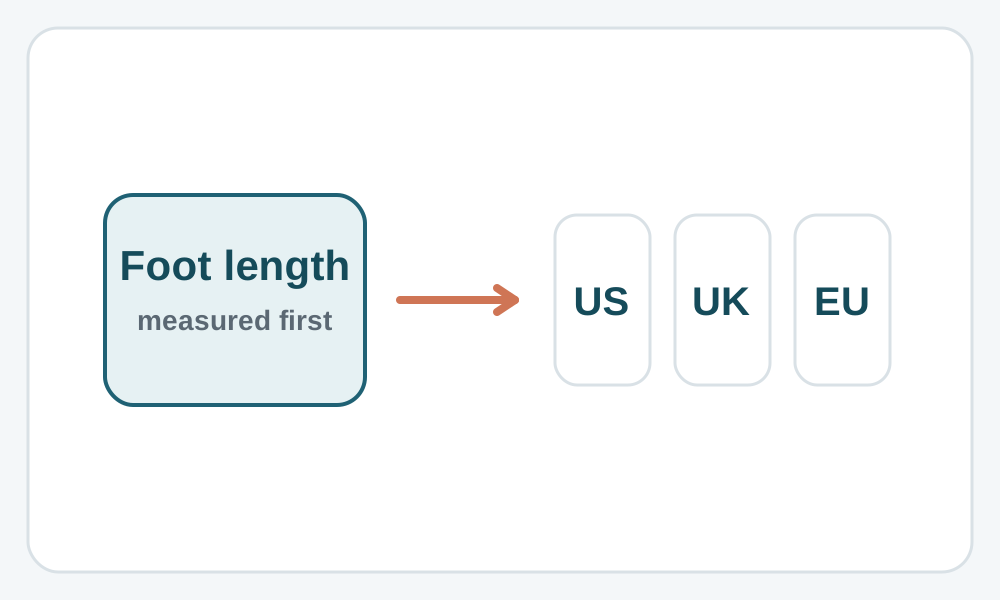
Why one foot can have several size labels
US, UK, and EU shoe sizes are numbering systems rather than direct measurements. They developed from different rules, so the same foot can legitimately map to several different labels depending on the system and whether the chart is for men, women, or children.
That is why Sizemapped treats foot length as the common denominator. The label is useful for shopping, but the measurement is the more portable piece of information.
US, UK, and EU sizing are not synchronized
A simple fixed offset sometimes looks accurate for a narrow part of a chart, but it can drift at the edges or between men’s and women’s systems. EU sizing also does not line up perfectly with every US or UK half size.
For a physical foot measurement, locate the closest Foot Length or Heel-to-toe row in the product maker’s chart and read across. The generic US/UK/EU/JP shoe-label comparison at Sizemapped is a different kind of table; its JP/CM number is not necessarily a measured foot length.
Foot length, shoe length, and fit allowance
Foot length describes the wearer. Shoe length describes the product. The difference between them includes toe room, construction, lining, last shape, and the amount of movement the designer expects.
Two brands can therefore recommend different printed sizes for the same measured foot without either chart being mathematically wrong. They may simply be using different fit assumptions.
Why width and last shape matter
Length is only one dimension of fit. A narrow toe box can feel short because the toes cannot spread, while a high-volume shoe may feel loose even when the length is appropriate.
When a converted size repeatedly feels wrong, check width, arch shape, instep volume, and the model’s last rather than assuming the conversion table itself is the only problem.
A practical conversion workflow
Measure both feet, keep the longer measurement, then open the manufacturer’s foot-length chart for the actual model. Find your measurement in its foot-length column before reading the recommended printed size. Only then use a general shoe-label chart to compare nearby US, UK, EU or JP/CM label conventions.
Use the generic conversion as a shortlist, not as a promise of identical fit. This is especially important for performance shoes, boots, narrow dress shoes, and any model where width or toe shape is critical.
How this guidance is checked
These sources support the measurement method and help check real-world variation. They are not presented as one universal brand-size table.
- ISO 19407:2023 — Footwear — Sizing — Conversion of sizing systems — International Organization for Standardization (ISO). Measurement-first footwear methodology and the limitation that cross-system conversions are guidance rather than guaranteed fit.
- Men's Footwear Size Chart — Nike. Manufacturer cross-check showing that foot length, labeled CM values, width, and brand-specific sizing conventions are distinct concepts.
- Footwear Size Guide — adidas. Manufacturer cross-check across heel-to-toe length and US, UK, EU, and Japan-labeled footwear sizes.
Frequently asked questions
Why do two shoe charts give different answers?
They may use different lasts, fit allowances, rounding rules, or target customers. Compare both charts against your measured foot length rather than choosing between labels alone.
Is EU sizing more accurate than US or UK sizing?
No system is automatically more accurate. Accuracy depends on how well a brand’s chart and shoe construction match your actual foot measurements.
See something that looks wrong? Report an issue.