International Clothing Size Conversion
International labels are generic references, not one synchronized global standard.
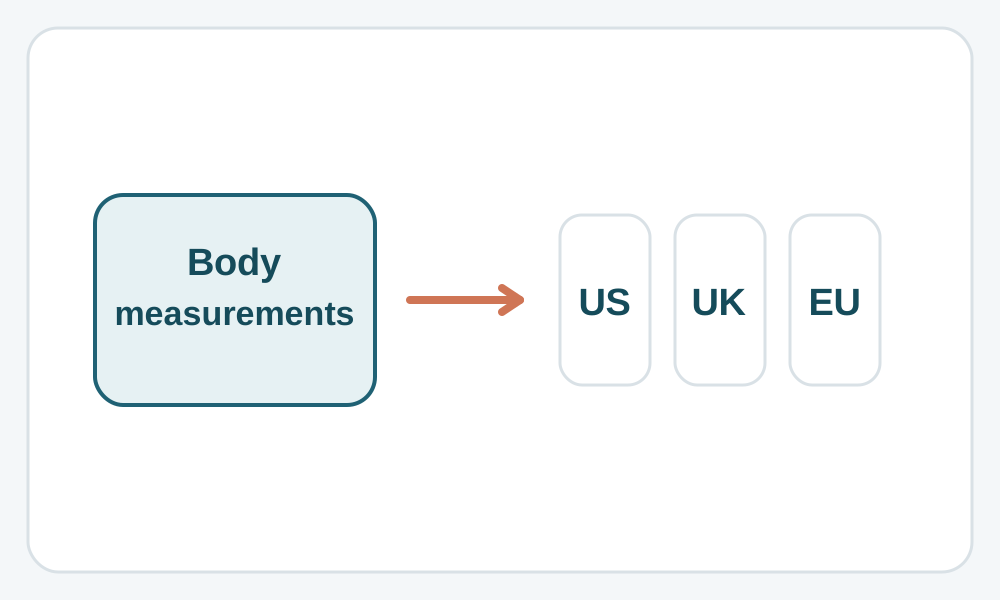
Why international labels are approximate
US, UK, EU, and letter sizes are not one synchronized global system. They are conventions used by manufacturers and markets, and brands can grade their patterns differently even within the same country.
That makes body measurements the best bridge between systems. A conversion table should narrow the likely range, not replace the seller’s chart.
Convert through the measurement row
Start with the measurement most important for the garment: bust or chest for many tops and jackets, waist and hip for trousers or skirts, and several dimensions for fitted dresses.
Find the row that best matches those measurements, then read across to the nearby US, UK, or EU label. This is safer than applying a fixed arithmetic offset to every size.
Letter sizes add another layer of variation
S, M, L, and XL are especially brand-dependent because each label covers a range rather than a single standardized body measurement.
When moving from a numbered size to a letter size, use the brand’s actual measurement range instead of assuming that every medium or large has the same dimensions.
When conversion tables are most useful
Generic tables are useful for unfamiliar stores, second-hand listings, travel shopping, and quickly narrowing a search. They are less reliable when the garment is highly fitted, the fabric has unusual stretch, or the brand uses a distinctive sizing block.
For expensive or difficult-to-return items, verify the final choice against the manufacturer chart and product reviews about fit.
How this guidance is checked
These sources support the measurement method and help check real-world variation. They are not presented as one universal brand-size table.
- ISO 8559-2:2025 — Size designation of clothes — Primary and secondary dimension indicators — International Organization for Standardization (ISO). Clothing methodology: size designation should be based on defined body measurements rather than assuming universal retail labels.
- ISO 8559-3:2018 — Methodology for body measurement tables and intervals — International Organization for Standardization (ISO). Clothing methodology: body measurement tables are population- and interval-based rather than one universal brand-independent chart.
- Ladies Size Guide — H&M. Cross-check for women’s US/UK/EU clothing labels and bust, waist, and hip body measurements.
- Women's Clothing and Underwear Size Charts — Calvin Klein. Second-brand cross-check for women’s pants, dresses, outerwear, and the variation in numeric sizes at similar body measurements.
Frequently asked questions
Is there one official US-to-EU clothing formula?
No single formula works across all brands and garment categories. Use measurements and the product chart whenever possible.
Why do two EU size charts disagree?
Brands can use different body ranges, fit ease, and grading conventions even when the printed EU label is the same.
See something that looks wrong? Report an issue.