How to Measure for Clothing Size
Good clothing conversion starts with consistent body measurements.
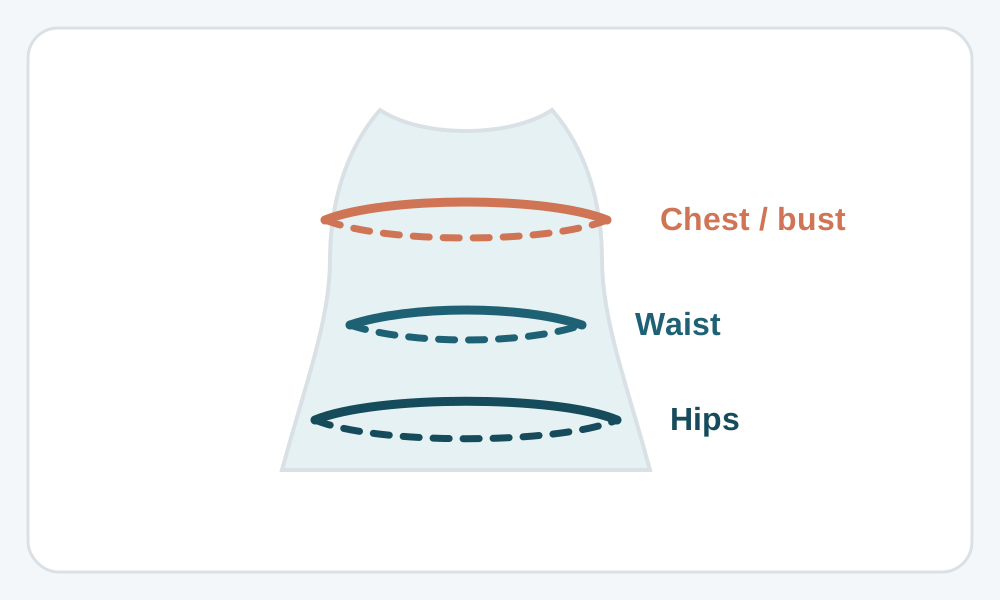
Use a flexible tape and measure consistently
Stand naturally and keep the tape level without compressing the body. Measure over light clothing or underwear when practical so bulky layers do not distort the result.
Record measurements before rounding. If you are between chart ranges, the unrounded values help you see which body dimension is actually limiting the choice.
Bust or chest
Measure around the fullest part of the bust or chest with the tape horizontal across the back. Keep a natural posture and breathe normally rather than expanding or collapsing the chest.
For shirts, jackets, and suits, chest or bust is often the first measurement to compare, but shoulder width, garment ease, and intended layering still matter.
Waist and hips
For the natural waist, measure around the narrowest comfortable point of the torso unless the garment chart specifies another location. For hips, measure around the fullest point of the seat and hips.
Trousers, fitted dresses, and skirts may be limited by different measurements. When one measurement points to a larger size, the garment cut determines whether you can safely choose the smaller option.
Body measurements versus garment measurements
Body measurements describe the wearer. Finished-garment measurements describe the item itself and include some amount of ease or stretch. A 100 cm garment chest is not intended for a 100 cm body unless the maker explicitly says so.
Always identify which kind of chart you are reading before comparing numbers.
How this guidance is checked
These sources support the measurement method and help check real-world variation. They are not presented as one universal brand-size table.
- ISO 8559-2:2025 — Size designation of clothes — Primary and secondary dimension indicators — International Organization for Standardization (ISO). Clothing methodology: size designation should be based on defined body measurements rather than assuming universal retail labels.
- ISO 8559-3:2018 — Methodology for body measurement tables and intervals — International Organization for Standardization (ISO). Clothing methodology: body measurement tables are population- and interval-based rather than one universal brand-independent chart.
- Ladies Size Guide — H&M. Cross-check for women’s US/UK/EU clothing labels and bust, waist, and hip body measurements.
- Women's Clothing and Underwear Size Charts — Calvin Klein. Second-brand cross-check for women’s pants, dresses, outerwear, and the variation in numeric sizes at similar body measurements.
Frequently asked questions
Should I pull the tape tight?
No. Keep it in contact with the body without compressing tissue unless a specific measuring method says otherwise.
What if my measurements point to different sizes?
Use the dimension that is hardest for the garment to accommodate, then consider fabric stretch, silhouette, and alteration options.
See something that looks wrong? Report an issue.