How to Read a Size Chart
Before comparing numbers, identify whether a chart lists body measurements or finished-garment measurements.
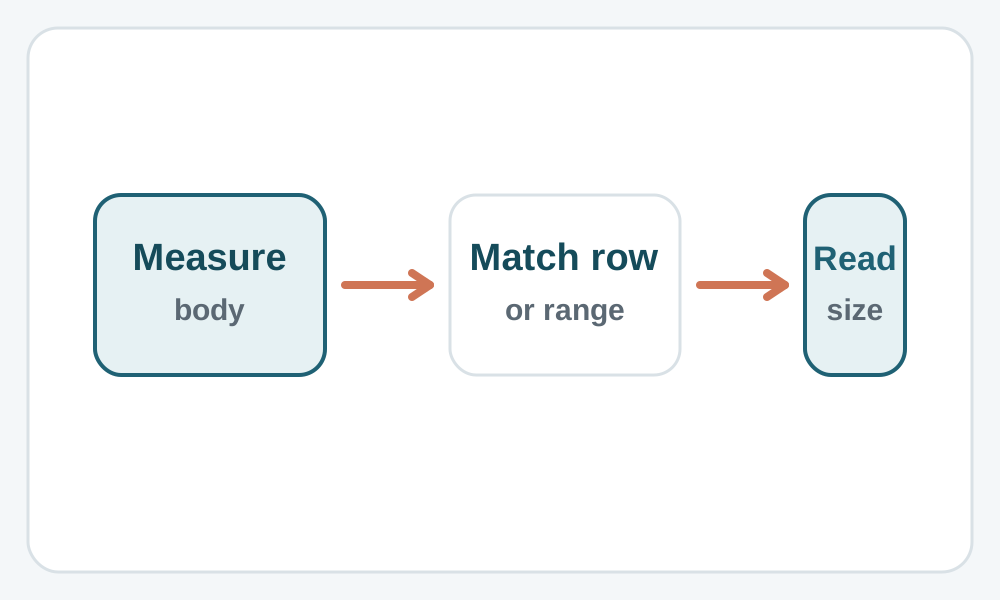
First identify what the numbers describe
A size chart may list body measurements, finished-garment measurements, foot length, head circumference, or a mixture of labels and measurements. Do not compare numbers until you know which type of value you are looking at.
Body measurements describe the wearer. Garment measurements describe the item and usually include design ease. Confusing the two is one of the fastest ways to choose the wrong size.
Read ranges instead of chasing one exact number
Many charts use ranges because a size is expected to fit more than one body measurement. If your value falls near a boundary, look at the next most important measurement and the fabric or fit notes.
Being between sizes is normal. A chart is a decision aid, not a test with one mathematically perfect answer.
Use the garment category to decide what matters most
Shoes are strongly anchored to foot length, hats to head circumference, belts to the actual worn position, shirts to chest or bust and sometimes neck, and trousers to waist, hip, and inseam.
For multi-dimensional garments such as dresses and jackets, the limiting measurement may determine the starting size even when the other measurements fall into a smaller range.
Check units before converting
Make sure you know whether a chart uses centimeters or inches. Convert the measurement once and keep enough precision to avoid moving across a size boundary because of aggressive rounding.
When both units are supplied, use the one you measured directly rather than converting back and forth several times.
How this guidance is checked
These sources support the measurement method and help check real-world variation. They are not presented as one universal brand-size table.
- ISO 8559-2:2025 — Size designation of clothes — Primary and secondary dimension indicators — International Organization for Standardization (ISO). Clothing methodology: size designation should be based on defined body measurements rather than assuming universal retail labels.
- ISO 8559-3:2018 — Methodology for body measurement tables and intervals — International Organization for Standardization (ISO). Clothing methodology: body measurement tables are population- and interval-based rather than one universal brand-independent chart.
- Ladies Size Guide — H&M. Cross-check for women’s US/UK/EU clothing labels and bust, waist, and hip body measurements.
- Women's Clothing and Underwear Size Charts — Calvin Klein. Second-brand cross-check for women’s pants, dresses, outerwear, and the variation in numeric sizes at similar body measurements.
Frequently asked questions
What if I am exactly between two sizes?
Look at fabric stretch, intended fit, the most limiting body dimension, and the brand’s own recommendation for between-size customers.
Can I use a chart from another brand?
Only as a rough reference. Brand-specific charts can use different measurements for the same printed size.
See something that looks wrong? Report an issue.